Our Platform:
Rapid, Reliable,
and Results-Driven
Why Your Team Will Care
| Challenge | What Winda does |
|---|---|
| Hours lost stitching together SCADA feeds, well-test PDFs, and price data | Streams everything—sensors, files, market APIs—into one event bus within seconds of creation |
| Lag between event and decision | Sub-second anomaly detection + live dashboards; LLM chat explains why an alarm fired and how similar events were solved before |
| "Shadow spreadsheets" & duplicate data marts | Bronze/Silver/Gold Delta Lake governed by versioned schemas—one source of truth for engineering, finance, and ESG |
| Talent stuck wrangling data instead of engineering assets | Pre-built feature store, vector DB, and RAG pipeline so data scientists jump straight to models, not plumbing |
Business Outcomes We Commit To
2-5% Production uplift
from faster choke-optimization and downtime avoidance
25% Analysis time
for reservoir and facilities engineers (LLM-assisted root-cause & report drafting)
ESG you can audit
every methane reading, image tile, and corrective action kept in an immutable log
IT spend cut in half
versus point solutions, thanks to open standards (OSDU™, OPC UA, Delta) and serverless scaling
What Makes WINDA Technically Different
| Component | Tech Choice | Why it matters in Oil & Gas |
|---|---|---|
| Streaming bus | Apache Kafka w/ Schema Registry | Handles 100 k+ wellhead tags per field, guarantees replay for audits |
| Edge protocol gateway | OPC UA ↔ MQTT converters | Zero changes to legacy SCADA/PLC gear |
| Stream compute | Flink for real-time KPIs; Spark Structured Streaming for heavy seismic tiles | Same engine can down-sample 1 Hz pressure and 4 TB SEG-Y |
| Curated lakehouse | Delta Lake on object storage | ACID tables + low-cost archive—perfect for > 30 years log history |
| Feature & vector stores | Feast + Pinecone | One-click feed into classical ML and retrieval-augmented GPT-4o |
| RAG orchestrator | LangChain + domain-tuned GPT-4o | Answers in plain language but cites every PDF, LAS, and ticket it used |
| Serving API | GraphQL & WebSockets | Same endpoint powers Grafana tiles, Python notebooks, and the React chat widget |
| Security | IAM-scoped tokens, row-level data masking, BYOK encryption | Meets SOC 2, ISO 27001, and most national NDR rules |
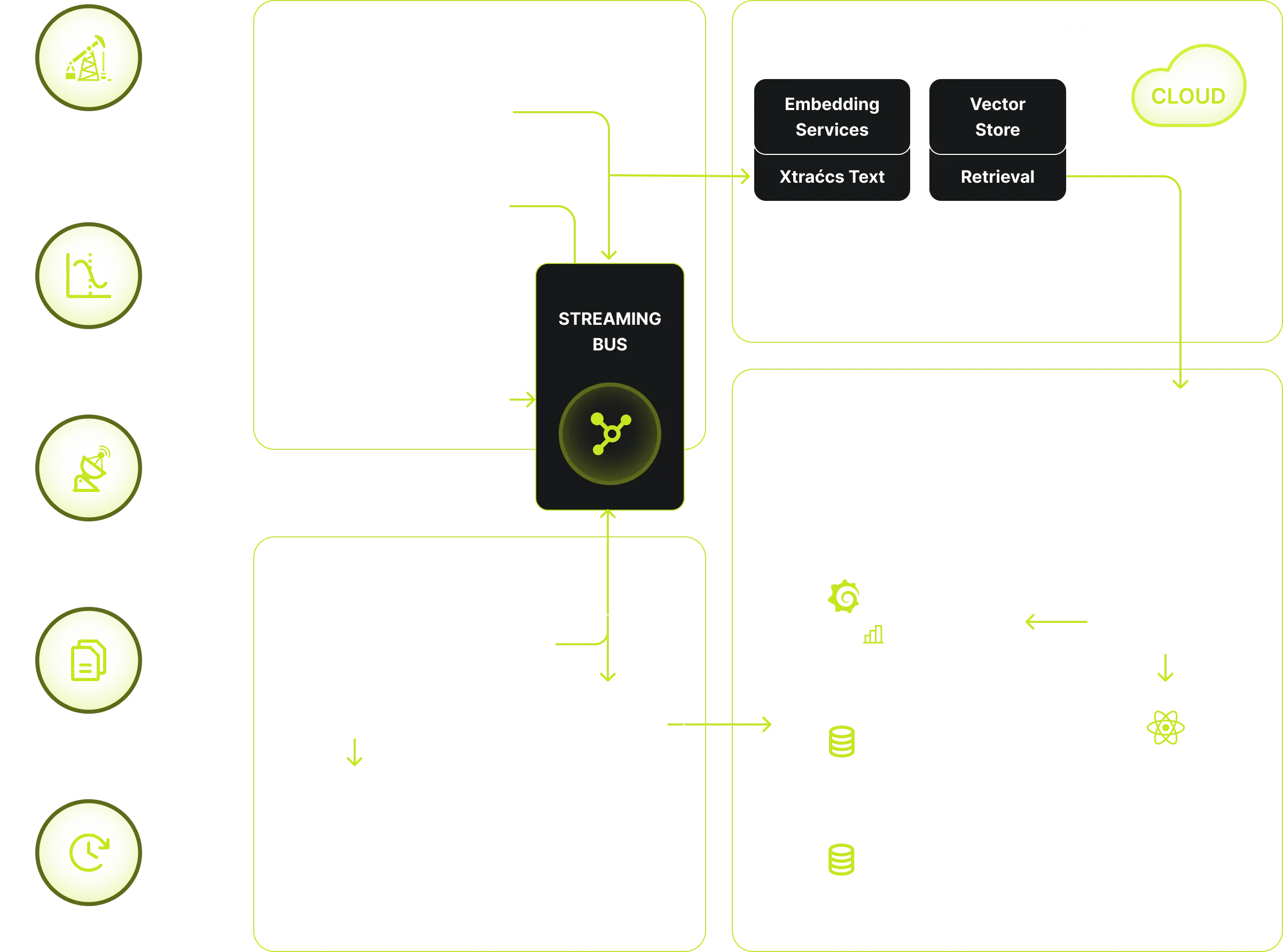
How It Works In Practice
01
Data lands
Pump off-controller pushes pressure every 500 ms → Kafka topic rig-01/pressure
New well-test PDF drops in Azure Blob → Event Grid fires Spark job
02
Streaming layer
normalizes units, flags spikes, and writes both to the lake (Silver) and to a time-series DB for dashboards.
03
LLM pipeline
OCRs the well-test, chunks the text, embeds it, and stores vectors. When an engineer asks,
"Why did well 17 trip yesterday?"
LangChain fetches the pressure anomaly, yesterday's well-test report, and last month's similar incident, then GPT-4o replies with a root-cause narrative and recommended choke setting—all fully cited.
04
Dashboard & chat
update instantly. Finance can query the same lake to reconcile flare volumes; ESG gets verifiable methane metrics.
Deployment & Support
- Cloud-native SaaS (AWS, Azure, or GCP) or hybrid with on-prem Kafka edge clusters
- Rollout in < 8 weeks: connect one pilot field, then scale basin-wide
- 24 x 7 managed service; upgrades and model tuning included
- Open APIs—no vendor lock-in; bring your own data science notebooks, BI tools, or private LLMs